


Your SEO Tip of the Day Reach out to influencers for backlinks.
Best Keyword Research Tools for SEO
Compare the best keyword research tools for SEO, including KeywordStat, Ahrefs, SE Ranking, Semrush, and Serpstat. Explore features, data accuracy, databases, pricing, and key differences.
Table of Contents
When choosing a keyword research tool, evaluate the accuracy of search volume data, the depth of the databases for your target region, the ability to find long-tail keywords and questions, data cleanliness and freedom from spam, the adequacy of keyword difficulty estimates, and the quality of clustering.
You Might Like: How To Make Money From Your Website?
Best Tools for Keyword Analysis
- KeywordStat: A new modern tool for keyword research and the leader of our ranking in terms of user interface, data accuracy, AI-powered clustering, and minimum monthly price.
- Ahrefs: Highly accurate, time-tested SEO analytics with an excellent keyword database for the US, a high price, and a system that limits the number of clicks.
- SE Ranking: A balanced SEO platform offering an intuitive interface, conservative, smoothed data, and a lower price.
- Semrush: The primary all-in-one platform for SEO analytics with a huge database covering various geographic regions and a high price.
- Serpstat: An affordable full-cycle platform with relatively high-quality data for Europe, a somewhat outdated table-based workflow, and a very attractive price.
Keyword Research Tools
Choosing a keyword research tool always depends on your budget and your actual needs. You need to understand from the start whether it is worth paying extra for additional features or choosing a tool designed exclusively to perform a specific task.
Most services on the market generally fall into two types: large, multifunctional SEO platforms and specialized tools.

The main difference between them lies in the accuracy and sources of their data. All-in-one platforms rely on their historical databases and clickstream data, while specialized tools most often analyze autocomplete suggestions, use Google Keyword Planner data, and apply AI for clustering.
To make the decision easier for you, we analyzed all well-known keyword research tools for different tasks and budgets. We selected the 5 most popular ones for you.
The research was conducted for the US region using the queries “SEO” and “Keyword Research.”
You Might Like: Why Every Small Business Needs a Local Marketing Agency
KeywordStat
This is the best tool in our ranking and offers an ideal price-to-value ratio. KeywordStat is a modern specialized keyword research tool.
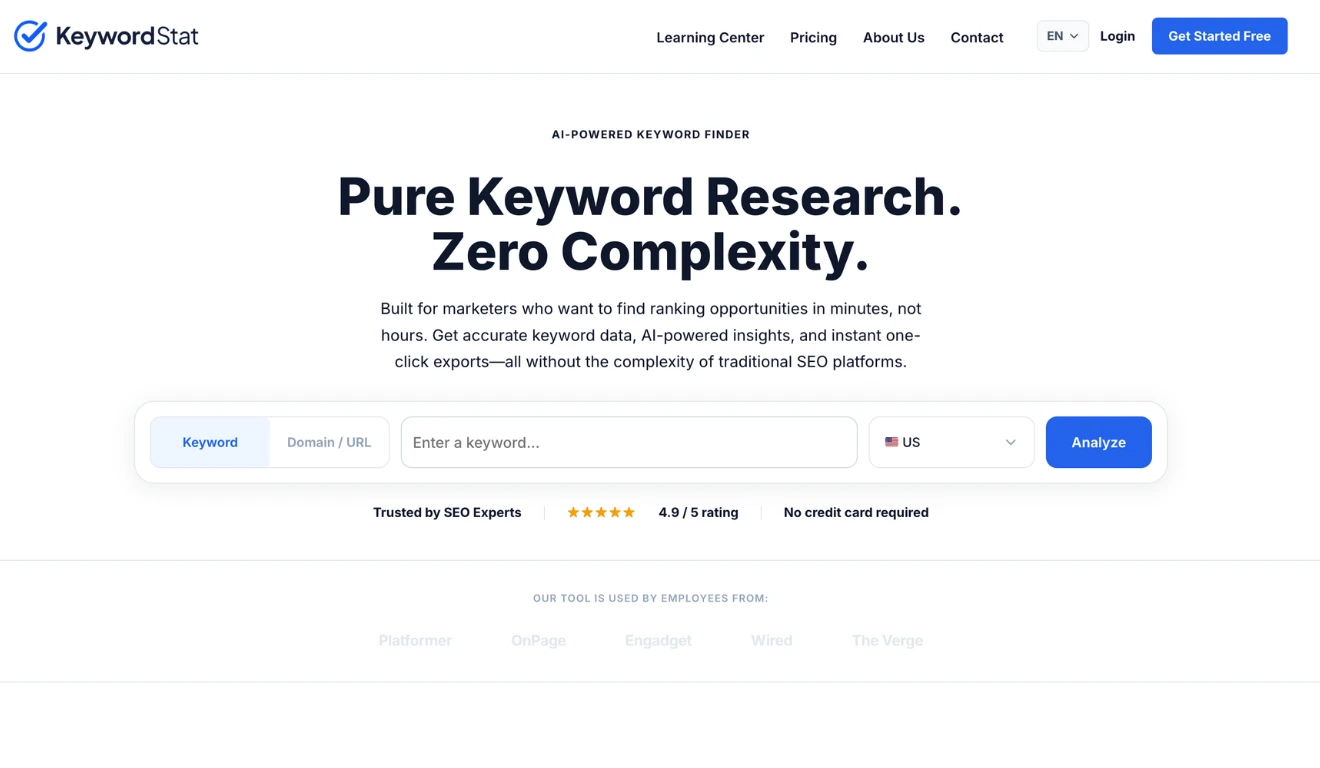
The user enters a main keyword or seed keyword for research, or can enter a domain or specific URL for analysis.
After the analysis, this Keyword Finder shows the main SEO metrics, displays a dashboard with the key SEO metrics, and then allows you to expand the keyword list, find additional keywords, group them, download them, or copy the keywords found. The workflow is quite simple.
First, you enter a seed keyword or URL. When analyzing a keyword, you get a dashboard with the following metrics for each keyword:
- Search Volume;
- Keyword Difficulty;
- Traffic Potential;
- Global Volume;
- Search Intent;
- CPC;
- Commercial Value;
- Trend.
You can expand the keywords, find additional keywords, update metrics for selected keywords, cluster them, or save the project.
You Might Like: Top 10 WordPress Plugins You Should Install on Your Website
KeywordStat Interface
One of the main advantages that stands out when working with the KeywordStat Tool is that it has a simple, clear, and modern interface. It is designed in a minimal style, but at the same time it is quite bright and easy to read.
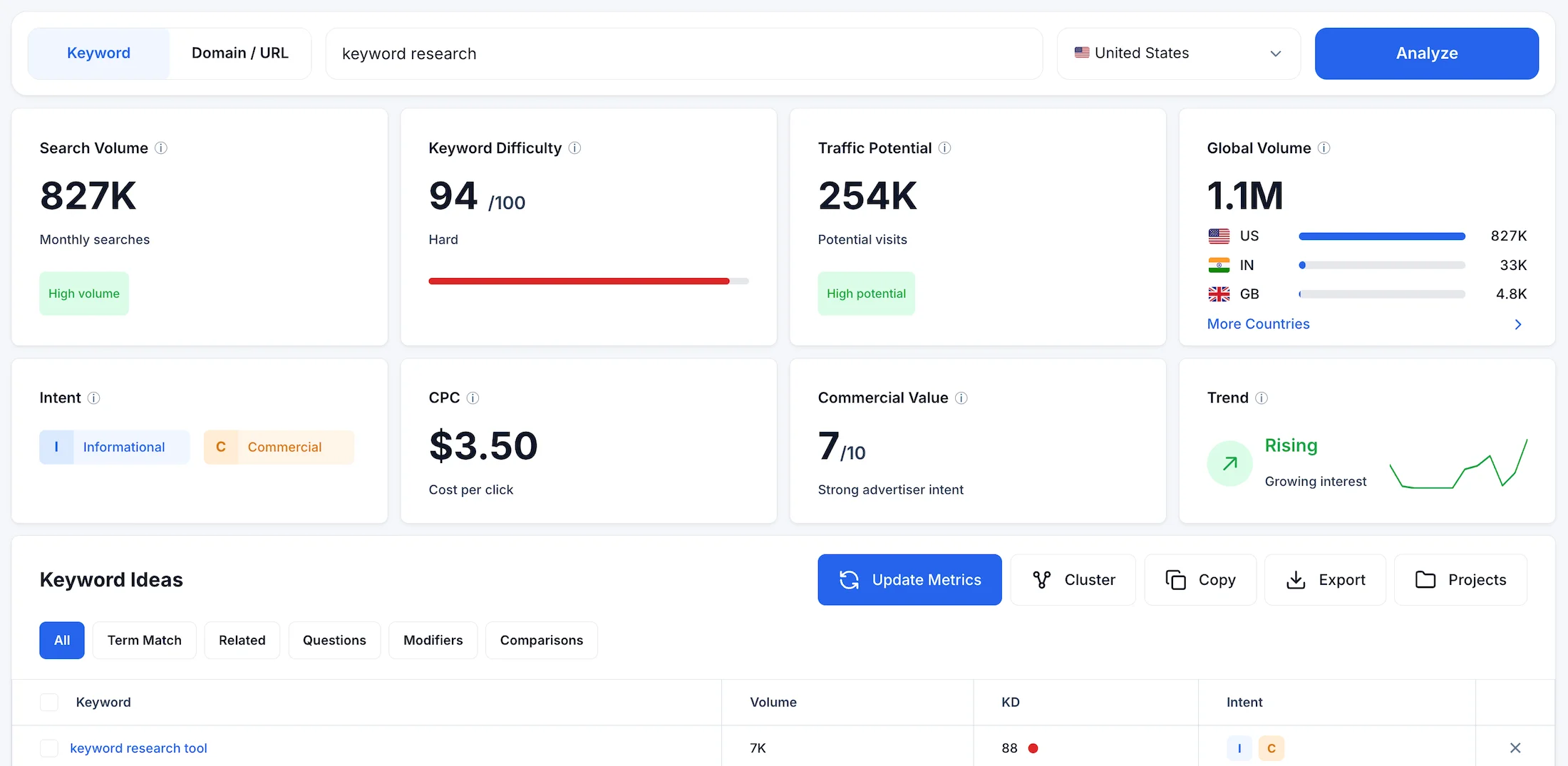
On the main page, you enter a keyword or domain URL, select the country you need, and start the analysis.
This is a convenient workflow because you do not need to figure out how the platform works. There is an initial query, and then you get the data you need for your research.
Next, you go to the Keyword Ideas section and start researching keywords.
Here you have several options for expanding keywords: term match, related, questions, modifiers, comparisons.
You Might Like: TikTok Marketing Techniques To Drive Brand Growth
Domain and URL Analysis
If the project already exists, or you can look at its keywords, or if you know your competitor, you can view their keywords.
To do this, you need to enter either the domain or the URL of the competitor's website. During the analysis, the service will show you directions that you can use for further work. You have access to the following metrics.
After the analysis, you get the Primary Keywords metric — the main keywords that the page is optimized for — and Secondary Keywords — additional keywords.
There are also fields such as Likely Targets, Opportunities, and Content Gaps. Clicking on each keyword takes you back to keyword research, which is the initial stage.
Keyword Clustering
In KeywordStat, clustering is performed using two methods: soft clustering and hard clustering. Simply put, soft clustering is a broader grouping of related queries, while hard clustering is a stricter grouping of queries belonging to the same cluster.
Data Sources
When comparing the data shown by KeywordStat with other services, we found that it provides data comparable to the market leaders. KeywordStat has more than 28 billion keywords in its database.
You Might Like: How to Boost Engagement Across Social Media Platforms
KeywordStat uses an aggregated data collection method, collecting keywords through its own crawlers, using search engine APIs and large-scale data, as well as artificial intelligence to process queries, clean the data, cluster keywords, and filter out irrelevant data.
KeywordStat Pricing
KeywordStat has both paid and free plans, which is enough to test the basic principle of how it works.
You get two analyses per day completely free of charge and without registration. You simply need to sign in with a Google account.
You then get access to five analyses per day for registered users and up to 250 keywords in a single analysis. You get all the main metrics, standard exports, and clustering — everything is available to you.
For more extensive work, there are plans that cost $9 and $29 per month.
Who Is KeywordStat For?
The service is designed for those who work with keywords on a regular basis. This tool is intended not only for beginners but also for SEO professionals. It can be used by specialists of different levels to quickly collect and evaluate keywords.
You Might Like: Learn How Google Reviews Boost Your Local Business
Ahrefs
Ahrefs is one of the best-known tools for SEO and keyword research. It is not just a keyword research tool, but a full-fledged SEO platform with a large number of tools for analyzing search traffic, competitors, backlinks, and content.
When analyzing keywords, the user enters a main keyword for research, or can enter a domain or specific URL for analysis.
After the analysis, Ahrefs shows the main SEO metrics, allows you to get keyword ideas, evaluate competition, see potential traffic, and explore the keywords that competitors are already ranking for.
The main tool for keyword research is Keywords Explorer.
When analyzing a keyword, you get the following main SEO metrics:
- Search Volume;
- Keyword Difficulty;
- Traffic Potential;
- Global Volume;
- CPC;
- Clicks;
- Return Rate;
- Parent Topic.
Ahrefs allows you to expand your keyword universe using various keyword idea options. You can find matching terms, related terms, search suggestions, questions, and other related queries.
You Might Like: How to generate SEO-Friendly sitemaps Instantly
Ahrefs Interface
One of the features of Ahrefs is the large number of functions, so the interface looks more comprehensive compared with specialized keyword research tools.
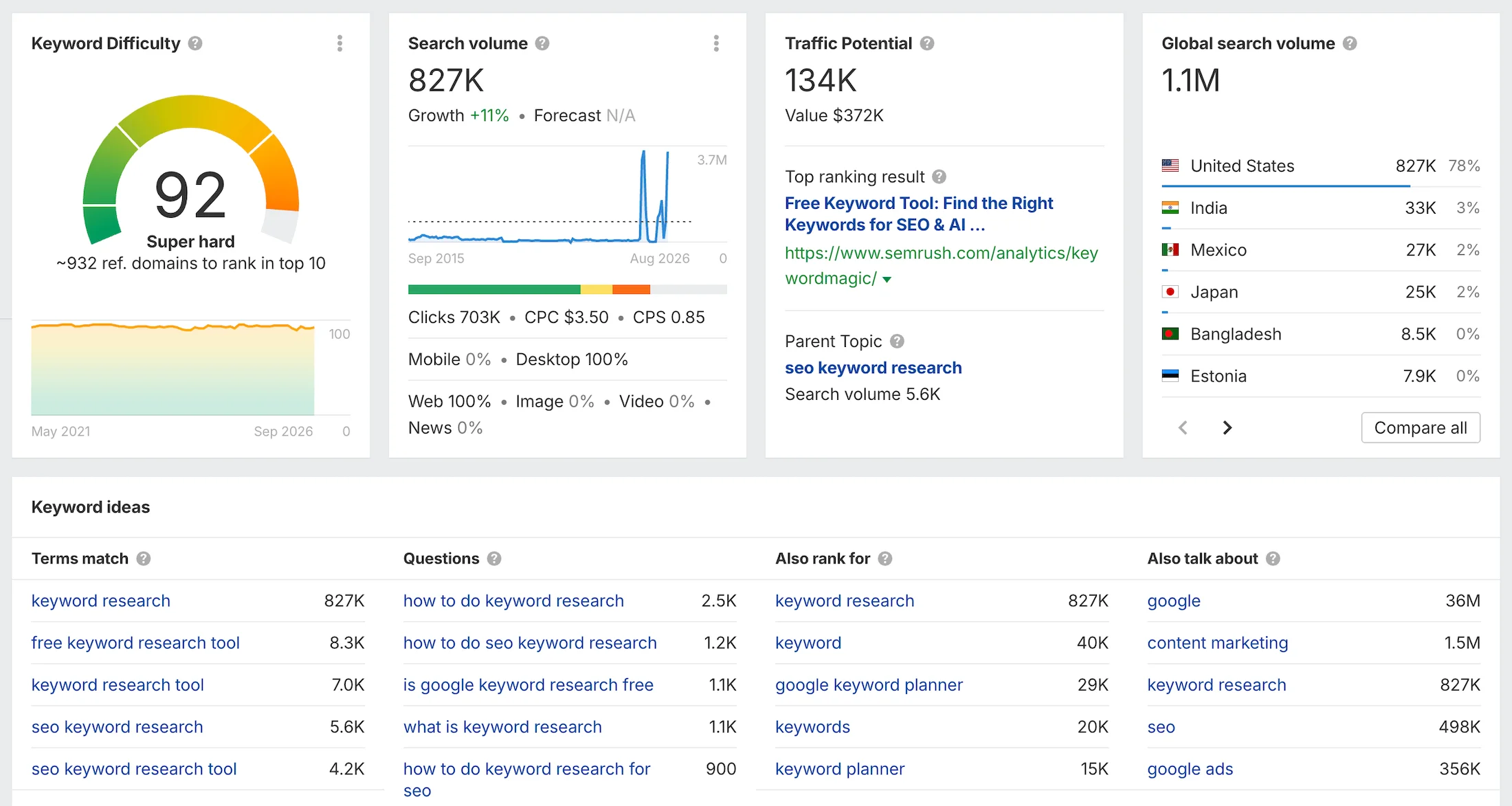
A large number of filters allows you to further narrow down results by Search Volume, Keyword Difficulty, Traffic Potential, CPC, and other parameters.
Domain and URL Analysis
Ahrefs is particularly widely used for analyzing existing websites and competitors.
To do this, you can enter a competitor's domain or specific URL and view its organic keywords.
Keyword Clustering
Ahrefs does not have a separate clustering tool that serves as a core part of the workflow in the same way as in specialized keyword research tools.
You Might Like: Compare Code Side-by-Side Instantly!
However, the data can be filtered, grouped, and analyzed according to various parameters. Parent Topic and SERP data can be used to build a content structure.
Data Sources
Ahrefs uses its own large search data database (28.7 billion keywords in the database) and its own infrastructure for collecting and processing information.
The company independently collects a large amount of data about search results, keywords, pages, and website backlink profiles.
Ahrefs Pricing
Ahrefs has paid plans starting at $129 per month, with various limits on the number of projects, reports, keywords, and other operations.
The cost of the platform is significantly higher than that of specialized, low-cost keyword research tools.
Who Is Ahrefs For?
Ahrefs is suitable for SEO specialists, agencies, website owners, and companies that need a full-fledged SEO platform rather than just a keyword research tool.
You Might Like: Wingdings Translator Online Tool
SE Ranking
SE Ranking is a balanced SEO platform that combines keyword research, competitor analysis, rank tracking, and other SEO tools.
The user enters a main keyword or seed keyword for research, or can enter a competitor's domain or URL for analysis.
When analyzing a keyword, you get the following main SEO metrics:
- Search Volume;
- Keyword Difficulty;
- Organic Competition;
- CPC;
- Traffic Potential;
- Search Intent;
- SERP Features;
- Keyword Trends.
The service shows options for expanding the keyword universe. You can find similar keywords, related queries, questions, and other search phrase variations.
SE Ranking Interface
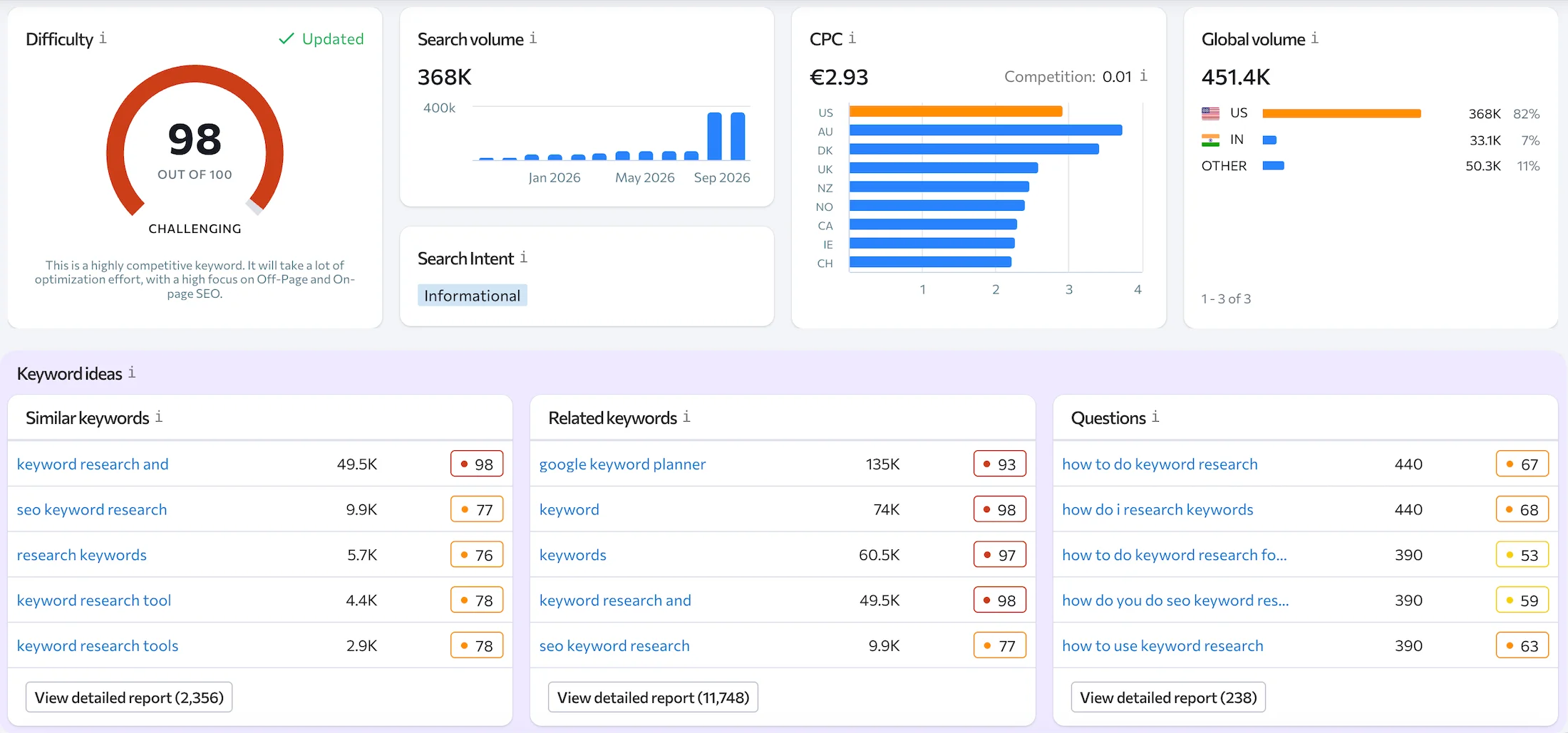
SE Ranking has a fairly clear and well-structured interface.
You Might Like: Top 5 Secrets of Professional SEO Article Writers
On the main page, you select the Keyword Research tool, enter a keyword, select the country and search engine you need, and start the analysis.
After that, you are taken to the research results page.
Keyword Clustering
SE Ranking has separate options for grouping and clustering keywords. However, they are available on the paid plan.
Data Sources
SE Ranking uses its own infrastructure and databases to collect and process SEO information.
The platform collects data about keywords (5.4 billion keywords in the database), search results, website rankings, and competitors, then processes it and provides it to the user through a unified interface.
Data in SE Ranking generally looks more conservative and smoothed compared with some other SEO tools.
You Might Like: Top 10 Mistakes to Avoid in your Multivendor Marketplace
SE Ranking Pricing
SE Ranking offers several paid plans starting at $103 per month.
At the same time, the user gets not only Keyword Research but also other tools for working with SEO: rank tracking, competitor analysis, website auditing, and other features.
Who Is SE Ranking For?
SE Ranking is suitable for SEO specialists, agencies, website owners, and small companies that need a balanced set of SEO tools.
Semrush
Semrush is an all-in-one SEO platform that combines keyword research, competitor analysis, rankings, organic traffic, technical auditing, and a large number of other marketing tools. It is one of the best-known services for comprehensive SEO analytics.
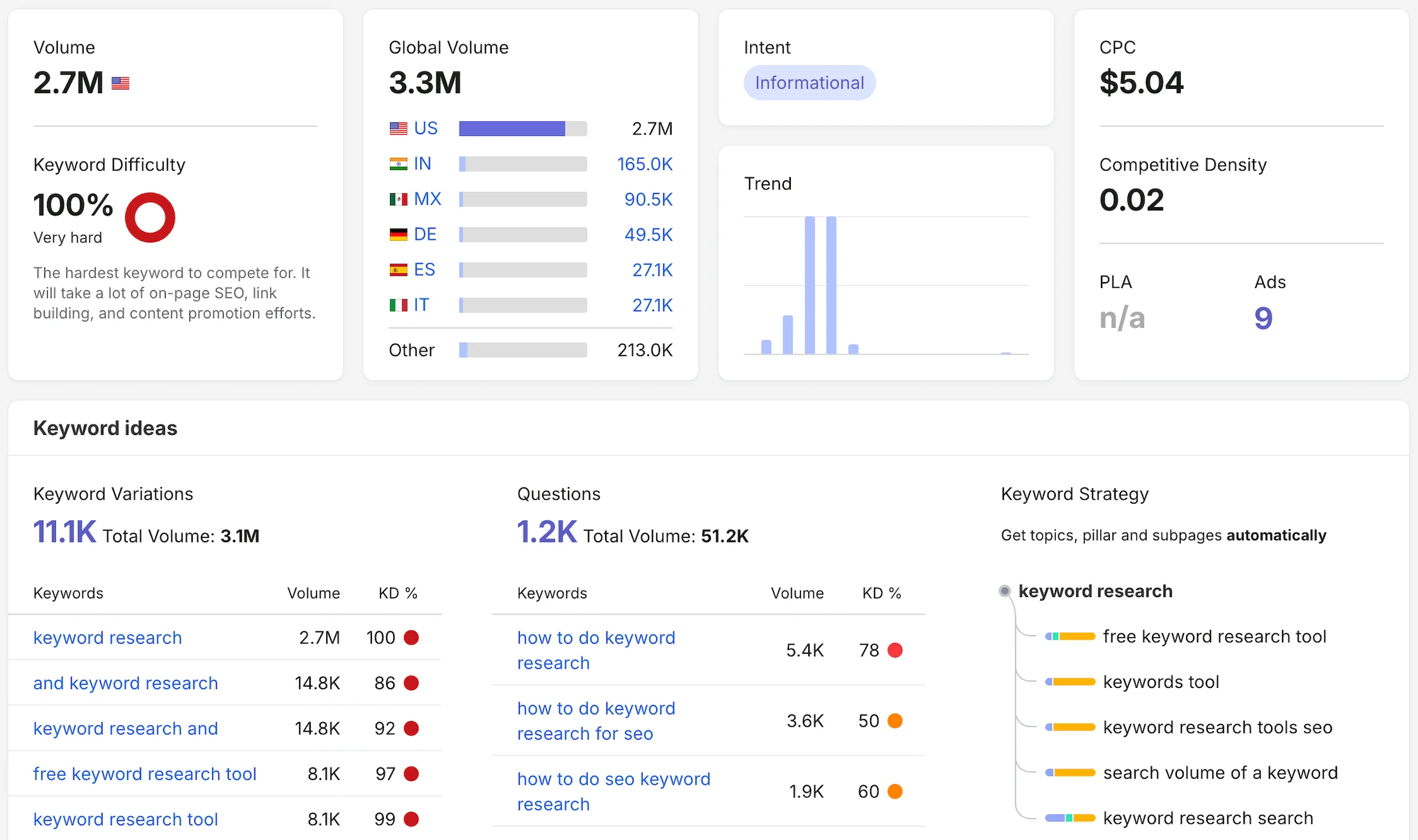
The main tools for keyword research are Keyword Overview and Keyword Magic Tool.
When analyzing a keyword, you get the following main SEO metrics:
You Might Like: What Does the Term Sandbox Mean in SEO?
- Search Volume;
- Keyword Difficulty;
- Intent;
- CPC;
- Competitive Density;
- Trend;
- SERP Features;
- Global Volume.
One of the strengths of Semrush is the large number of options for expanding the keyword universe.
Semrush Interface
Semrush has a fairly comprehensive interface because the platform includes a large number of tools not only for SEO but also for other areas of digital marketing.
Domain and URL Analysis
One of the main use cases for Semrush is competitor analysis.
To do this, you can enter a competitor's domain or specific URL and view organic keywords, rankings, and estimated organic traffic.
After the analysis, Semrush shows which queries the site receives visibility for in search results.
You Might Like: How to Simplify Buying with WooCommerce Variation Swatches
Keyword Clustering
Semrush has tools for grouping and organizing keywords that allow you to work with large keyword sets.
Keywords can be combined into lists and grouped according to various parameters.
Data Sources
Semrush uses its own databases and infrastructure to collect and process SEO information.
The platform collects data about search queries (28.8 billion keywords in the database), search results, keywords, competitors, and advertising activity.
One of the advantages of Semrush is its extensive geographic coverage. The database includes a large number of countries and regions, so the service can be used for international SEO and work across different markets.
Semrush Pricing
Semrush is among the more expensive SEO platforms.
You Might Like: How to check competitor hosting information
The service offers several pricing plans starting at $117 per month.
The cost depends on the selected plan and billing period.
Who Is Semrush For?
Semrush is suitable for SEO specialists, agencies, large websites, and companies that need a universal platform for comprehensive SEO analytics.
Serpstat
Serpstat is an affordable all-in-one SEO platform that combines keyword research, competitor analysis, rank tracking, website audits, and other SEO tools.
The service focuses primarily on practical SEO analysis and keyword research.
Serpstat Interface
The Serpstat interface is built around tables and individual reports.
You Might Like: How to Grow a YouTube Channel?
On the main page, you select Keyword Research, enter a keyword, select the country you need, and start the analysis.
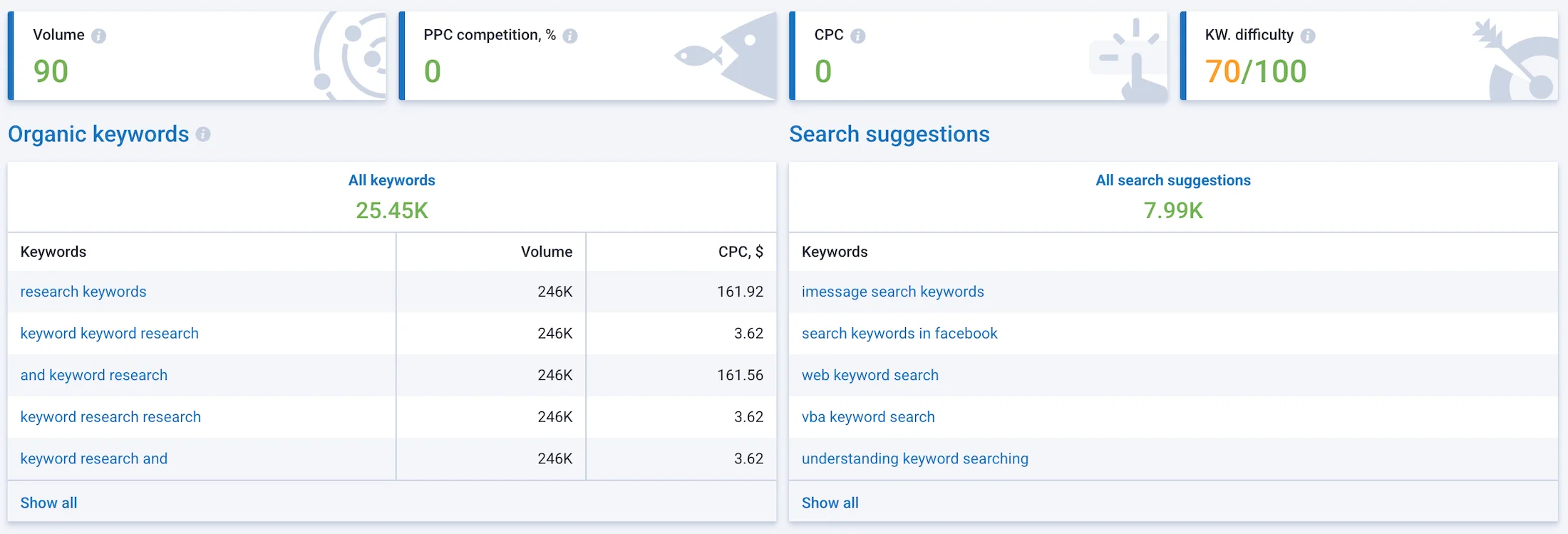
After that, the service shows the main metrics and a list of the keywords found.
The workflow is fairly straightforward, but visually the interface looks more outdated compared with modern specialized tools.
Keyword Clustering
Serpstat provides options for grouping keywords and working with a semantic core.
Keywords can be combined into groups and used for further page planning.
You Might Like: 8 Tips for Writing SEO Content to Increase Traffic and Sales
Grouping takes into account the similarity of search results for different queries. This makes it possible to determine which keywords may belong to the same page.
For large keyword sets, this approach helps reduce the amount of manual work.
Data Sources
Serpstat uses its own databases to collect and process information about keywords (more than 7.46 billion keywords), search results, websites, and competitors.
Serpstat Pricing
One of the advantages of Serpstat is its relatively affordable price, starting at $50 per month.
The service offers several pricing plans that differ in the number of available queries, projects, keywords, and other operations.
Who Is Serpstat For?
Serpstat is suitable for SEO specialists, agencies, website owners, and small companies that need a set of essential SEO tools in one platform.
You Might Like: Best Marketing Automation Software to Streamline Campaigns
Conclusion
We conducted research on all popular keyword analysis services and took a detailed look at 5 of them, evaluating their main capabilities, interface, data sources, pricing, advantages, and disadvantages.
Each of these tools has its own strengths and weaknesses. KeywordStat focuses on simplicity, a modern interface, and affordable pricing, Ahrefs on in-depth SEO analytics and a large database, SE Ranking offers a balanced set of tools, Semrush is focused on comprehensive SEO analytics, while Serpstat combines a wide range of features with relatively affordable pricing.
Therefore, choosing a tool primarily depends on your needs, budget, and the data and features you require for your work.
We recommend trying these services yourself and comparing them using your own keywords and projects. This will help you understand which tool is best suited specifically for solving your marketing tasks.


